

 +86 18926159746



 HOME
HOMEDeployment Practice of 16 Channel Decoding Encoding Combiner in Multi Source Video Wall Project for Security Command Center
 Sep 22,2026

 Haiwei
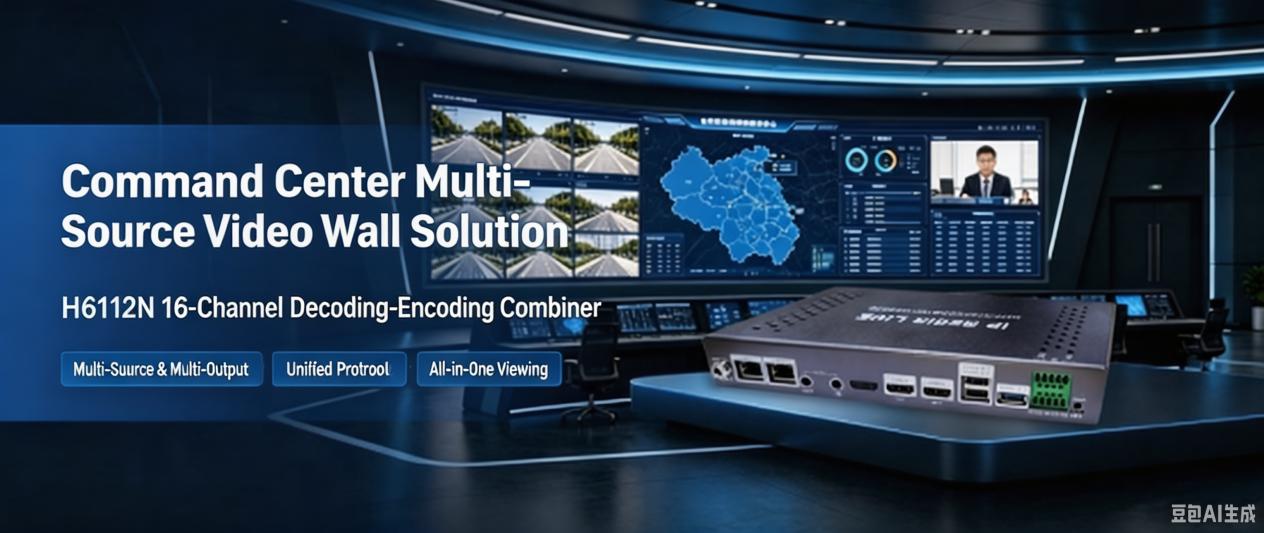
Deployment Practice of 16-Channel Decoding-Encoding Combiner in Multi-Source Video Wall Project for Security Command Center
Introduction
In security and emergency command center projects, video sources include local IPC cameras, NDI/SRT live push streams, WebRTC video conferences, third-party platform streams and many other formats. Traditional video decoding and wall-mounting solutions are plagued by excessive equipment, complicated cabling, and rigid video scheduling. In addition, a standalone NVR is required for storage, which poses challenges for small command rooms with limited space.
Taking the security command center project of one institution as an example, this document presents the integrated solution adopting the H6112N 16-channel decoding-encoding combiner. It delivers unified deployment for multi-source video decoding, large-screen splicing, as well as local video recording and storage.
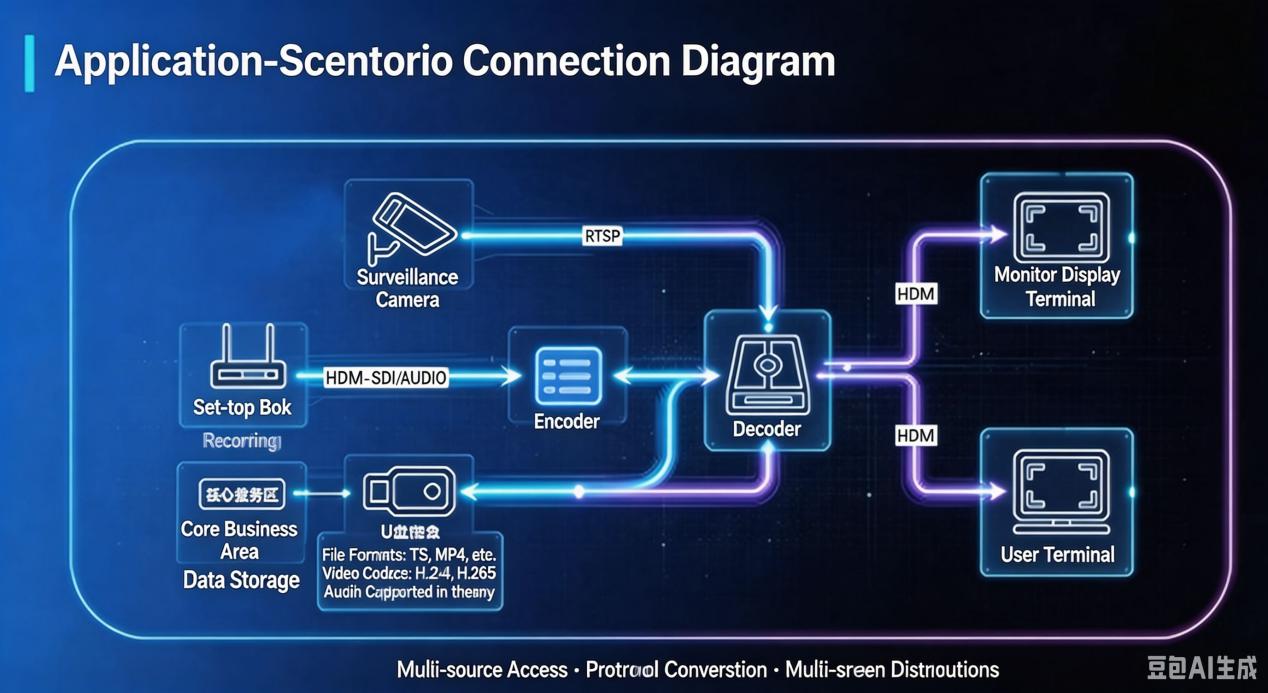
① Three Core Pain Points of Traditional Decoding-and-Wall-Mounting Solutions
1.Multiple protocols and diverse equipment result in high deployment and operation-maintenance costs In practical projects
video protocols such as IPC, RTMP, NDI, SRT and WebRTC cannot interoperate. Dedicated decoding hardware has to be procured separately for each streaming media type. Massive on-site equipment brings complex cabling, and increases workload for later-stage maintenance and fault diagnosis.
2.Restricted video scheduling for large screens, reliance on external splicing processors
Video output to display walls depends on independent splicing processors. Available modes for windowing, screen segmentation and splicing are fixed. Users cannot freely drag windows or adjust frame sizes. Multi screen heterogeneous display requirements are difficult to meet, lowering monitoring flexibility for command scenarios.
3.Separated decoding and storage systems occupy large cabinet space
Decoding wall-mount devices and recording-storage NVR operate as two independent hardware systems. Large-volume equipment consumes considerable rack space, creating deployment obstacles for small sized monitoring and command centers under budget constraints.
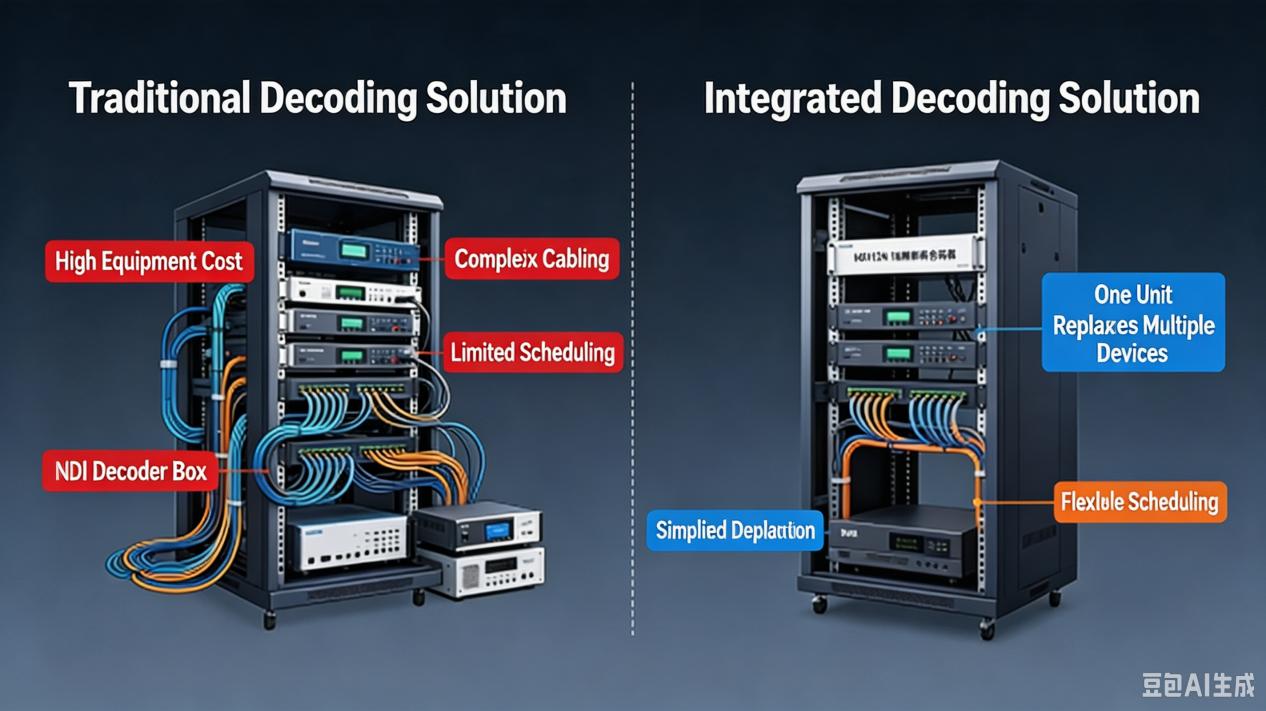
② Overall Project Construction Solution
A new security command center built by one institution sets core requirements: unified wall-mount output of heterogeneous multi-source videos, flexible window scheduling, and local video storage, so as to build a lightweight and complete monitoring system. This project adopts the combined architecture of H6112N 16-channel decoding-encoding combiner and matching NVR:
- Front-end multi-source videos are centrally ingested by the decoding-encoding combiner, with compatibility for network streams including RTSP, RTMP, UDP, NDI, RTP and WebRTC.
- After multi-channel hardware decoding, videos are output to large screens via dual-HDMI ports. Multiple video scheduling modes are supported, including screen segmentation, window pop-up, splicing and video rotation for wall display.
- The matched network video recorder enables synchronous recording for 16-channel videos, forming a closed-loop workflow of “on-screen viewing plus local storage”.
③ Core Equipment: Key Advantages of H6112N 16-Channel Decoding-Encoding Combiner
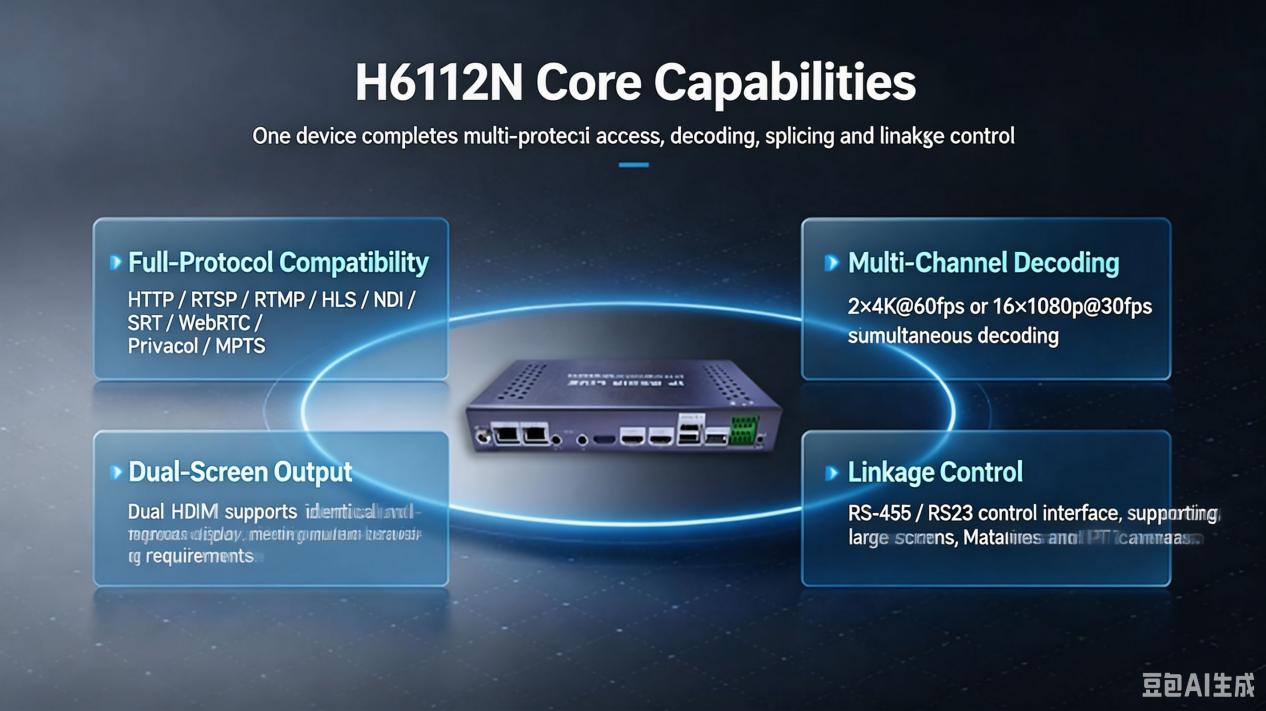
- Full-protocol compatibility, one unit replaces multiple dedicated decoders It supports mainstream streaming protocols: HTTP, HTTPS, RTSP, RTMP, HLS, FLV, UDP, NDI, WebRTC, SNLP, SRT, private protocols and MPTS. There is no need to purchase separate RTMP transcoder, NDI decoding box or SRT receiver. System architecture is streamlined to cut equipment procurement and cabling costs.
- Multi-channel hardware decoding; dual-HDMI supports identical-display and heterogeneous-display Decoding capacity adapts to monitoring requirements of different projects:
- 2-channel 4K@60fps synchronous decoding & output
- 4-channel 4K@30fps synchronous decoding & output
- 8-channel 1080p@60fps synchronous decoding & output
- 16-channel 1080p@30fps synchronous decoding & output
Equipped with dual-HDMI output interfaces, the device supports identical display (consistent picture on two screens) or heterogeneous display (independent window layout). Built-in functions for screen segmentation, splicing and rotation meet multi-zone split-screen monitoring requirements in command halls.
- Stable hardware with linkage capability for large-screen systems
- Processor: Octa-core ARM Cortex-A55 @1.6 GHz, 4 GB RAM, supporting 7×24-hour non-stop decoding
- Control interfaces: RS485 / RS232, directly connecting to large-screen displays, video matrixes and camera PTZs It can link with the whole display system to realize unified control over video switching and PTZ rotation, reducing peripheral central-control devices.
④ Matched NVR Architecture to Build a Complete “View-and-Storage-Integrated” Monitoring System
Cooperating with the decoding-encoding combiner, the matching network video recorder completes video storage capacity:
- Support up to 16-channel IPC simultaneous access, real-time recording and historical playback.
- 8 SATA hard-disk bays; each hard disk supports maximum 4 TB capacity to satisfy long-term video recording.
-
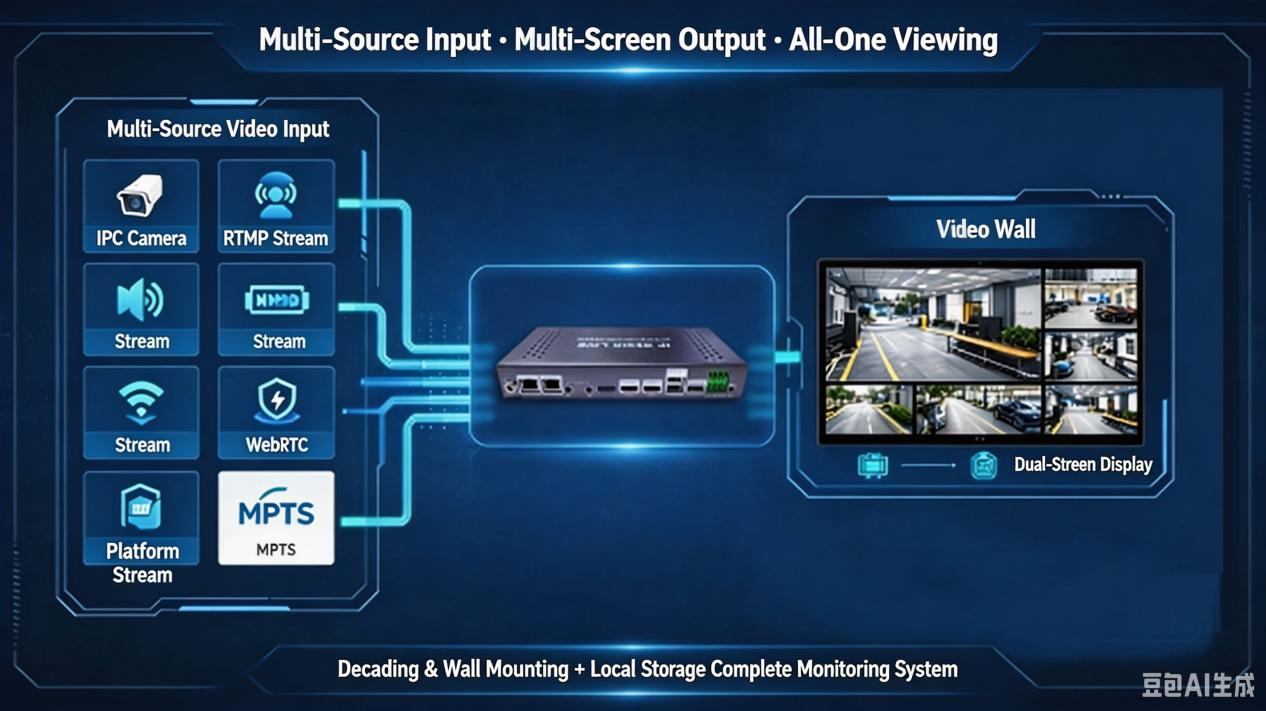
⑤ Three Core Values and Benefits Brought by Solution Implementation
- treamlined system, unify diverse video protocols A single hardware unit is compatible with mainstream streaming sources. It eliminates stacked devices, lowers on-site cabling workload and later-stage maintenance difficulty, and optimizes overall project cost.
- Flexible video scheduling for higher command-monitoring efficiency Multiple scheduling modes including segmentation, windowing, splicing and rotation are available for flexible layout of 16-channel video feeds. Dual-screen heterogeneous display can show monitoring feeds, GIS maps and video conference content simultaneously, satisfying multi-dimensional monitoring demands for command centers.
- Closed-loop view-and-storage integration for small-and-medium-sized command centers The combined solution of decoding-encoding combiner plus NVR delivers real-time monitoring and video archiving within one set, removing the need for two independent hardware systems. It saves cabinet space and fits deployment for government agencies, industrial parks, hospitals, small emergency command centers and other scenarios.
For full product specifications and system topology diagrams of command-center projects, security large-screen wall-mounting and broadcast multi-view monitoring, reply with [Decoding Solution] in official account background to obtain relevant documents.
Tags
#CommandCenterLargeScreen #SecurityVideoWallDecoding #NDIDecoder #WeakCurrentEngineeringSolution #IntegratedSurveillanceSolution
 Push Surveillance Video Directly to Live Streaming Platforms? One Integrated Gateway Connects the Entire Workflow
 You May Also Like


 Tel
Tel
 Email
Email
 Address
106, Building 2, Hangcheng Zhigu Zhongcheng Future Industrial Park, Hangcheng Avenue, Bao'an District, Shenzhen

Kevin Zhou
 Skype
Skype


 INQUIRY US FOR DISCOUNT